Thursday, May 20, 2010

The Watering Hole

In my day to day orbits I am always looking for birding opportunities. A few weeks ago I noticed a female Western Bluebird on a wire near a nesting box that has been on a tree stump for the past twenty years. Each time I pass by the tree I stop for a few moments to see if the Bluebirds are occupying the box. I have not seen any evidence that they are.   

A short distance away is a staging area used by the military to offload troops from transport trailers before they march to a near by training area. When I was in the military we lovingly called them “cattle cars”. The truck and trailer traffic on the graveled area has formed a depression on the wood line side where water collects and forms a large puddle during the rains. The puddle is near a road and the wood line but other then for troop movements no one visits the site. Earlier this week I was returning home from a chore orbit and passed by the nest box and again  found nothing. The puddle is on the way back to the hard topped road so it passed by it. Just as I approached the clouds opened up and the sun light blazed down on the flowering Scot’s Broom.

The puddle has been steadily diminishing in size since the weather warmed and the Spring rains have subsided. Amazingly even with  the Northwest being  noted for all of it’s rain when it is not raining water does become scarce quickly.  I stopped a hundred yards short of the puddle and scanned it with my binos. Immediately I saw a male Western Tanager take off from the one of the three smaller pools the puddle had been reduced to.  One second later my foot was on the gas. Being a fairly undisturbed area the birds do not take offense to cars parking near the water.


A couple weeks ago I pulled up and watched several Brown-headed Cowbirds feeding which then evolved in to a courtship dances.


Within moments a female Western Tanager and a male White-crowned Sparrow landed and suddenly took off. 


Then the male White Crowned Sparrow came back and abruptly took off.  A male Barn Swallow landed then took off.   


A female Robin landed, gathered a bill full of mud and abruptly took off.  I was beginning to notice a pattern here.


A pair of Goldfinches landed at the waters edge. The ghostly image of the cause of all of the stress at the watering hole suddenly appeared. A Killdeer that had been hiding in plain sight. The killdeer had been silently charging each bird as it landed a the edge of the water. I did not really see it until it lifted up and took wing to drive off the Goldfinches.  I began to worry that I might have unknowingly driven over a Killdeer nest hidden in the gravel.  In my previous visits I had not seen Killdeers at the puddle and had no reason to bring it to mind.

My worries quickly faded when I caught sight of movement on the far side of the smaller puddle.  A Killdeer chick was moving toward the water. In a few moments I found two others and a second adult Killdeer. The second adult Killdeer kept to the edge of the grass while the young approached the water, all the time it was sounding off with a regular “peep”. It would be best described as a rhythmic beacon allowing the chicks to know how far and in with direction the adult was. At this point I made this obvious conclusion, the second adult that was “peeping” was the female and the defender of the water was the male. He was clearing the way for the youngster that his mate was leading to the puddle.


Once the male had complete control of the area the female fell silent. She began to walk directly at while I was sitting in the driver’s seat of my car.  
I froze not wanting to cause her to sound an alarm. I found that I was holding my breath as the male began to walk to intercept her about ten feet from my car window. This whole time I was using the camera to cover my face so I slowly moved to a steady position and started taking this series of pictures.


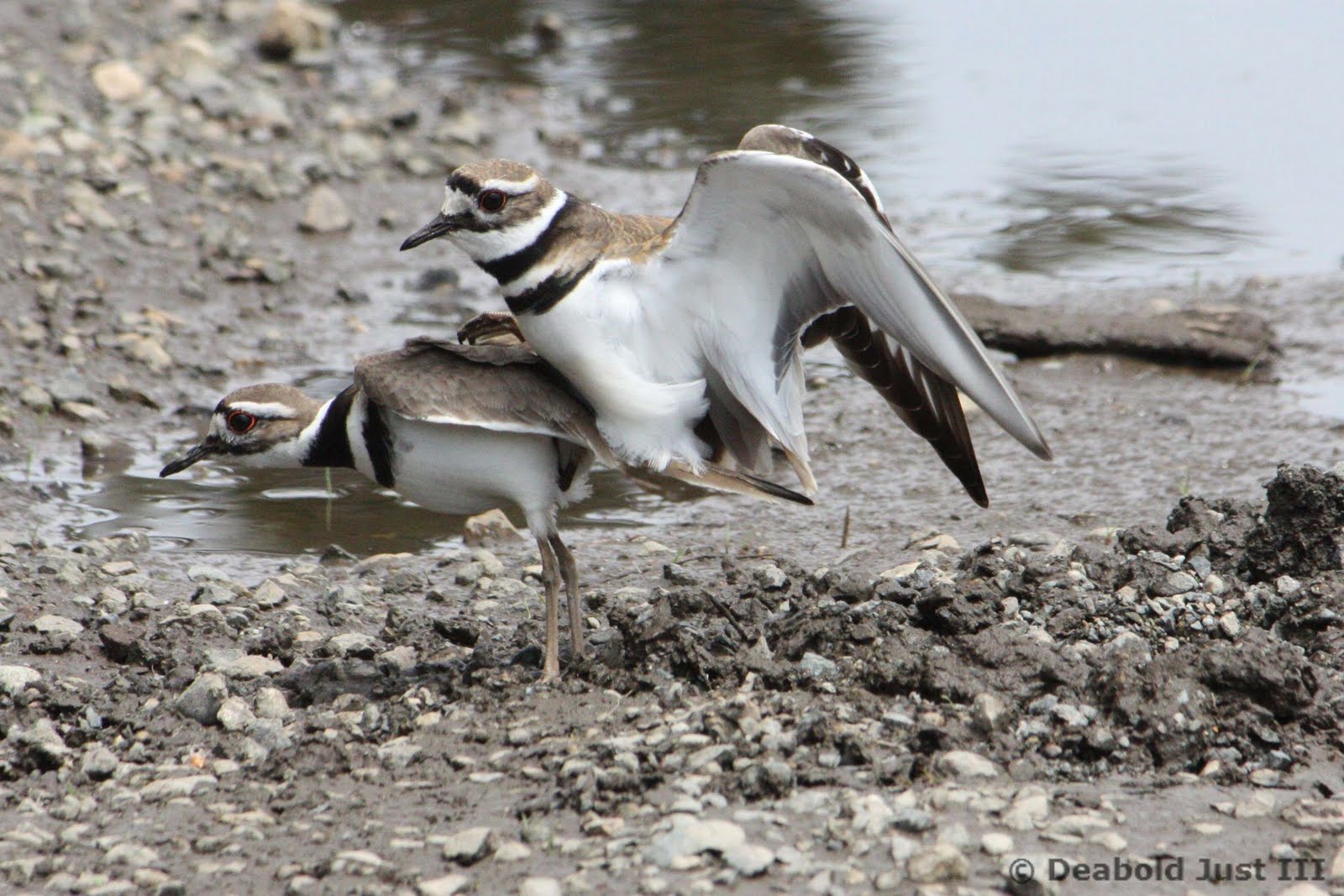


The female moved off and readjusted her feathers.


The male move off in the opposite direction to a larger portion of the puddle. A hen Mallard landed and began to feed. When ever the hen neared the edge of the puddle the Killdeer would rush over to it trying to intimidate her and drive her off as he had with all of the other birds. She ignored him.

After the adult Killdeer had moved back into the tall grass two of the young Killdeer moved closer to where I was sitting. This one offered my an unprecedented opportunity for close ups.


Today it was cold and raining again. I stopped by the puddle to see what was happening. Only the five  Killdeers were there. The instant I got out of the car one of the adults dropped to the ground and pretended to have an injured wing. The other, further away sounded an alarm and the three young birds scattered.

While I was standing there looking at the puddle with my camera in hand a large white pickup truck pulled off of the hard top and drove up to me. The driver, a man with a big mustache and cowboy hat asked,  "are you the contractor that's going to fill in the hole?"
............................................................................................................

For more photos and a another encounter with Killdeer, I posted a Blog entry back in May of 2008.
It can be seen at;

http://birdmandea.blogspot.com/2008/05/fuzzies.html

Thursday, May 6, 2010

First day on the job


Last weekend my wife lovingly planted her baby tomatoes. When she was done she turned and asked "do you think it will freeze this week?". I shrugged it off thinking back to how many Mays of the past twenty or twenty-five Mays that I have been here had frost. Then I thought of how many that were so cold the Bees did not get out to pollinate the fruit trees. Then my mind drifted off the the splendorous few that were idyllic and magical.  I grunted "I don't think so".


 This week the weather quickly went to shit.

The temperatures dropped into the high thirties with wind gust hitting upwards of sixty miles per hour. Snow levels dropped to two thousand feet in the mountains, thunder, lighting, pelting rain sleet, hail and ( I love this one)  deluged rain while the sun was shining on the marble sized hail on the road causing white out conditions WHILE a constant green swirl of leaves freshly stripped from the branches stuck the the car windshield wipers as the windows fogged over.


You know when things are bad when the open water Harbor Seals run for cover.
The eagle nest had a good twenty foot sway going before the big winds blew in on Tuesday.  All wildlife was hunkered down and sitting tight.

At some point during this prolonged tempest new eyes opened for the first time.  Last month four pairs of Canada Geese took a calculated risk by building nests and laying eggs. These "early birds" reaped a disappointing success.  Two of the pairs had one gosling each, one pair had tree and the best was a pair with five goslings.  The success rates have been much higher in past years. These ten little goslings as well a few other other surprises were all greeted by the harsh weather.


Wasn't there suppose to be a belly button here?  
After a prolonged search the said belly button was indeed missing.  S/he was actually instinctively preening after it's first icy cold swim from where the nest was to where food could be found.


Mother will show you what to eat.


Any port in a storm.
Never was a phrase so literal. Moments after I took this picture a near white out sleet storm and wind gust churned up whitecaps on the tidal waters of the creek and drove both for better cover.

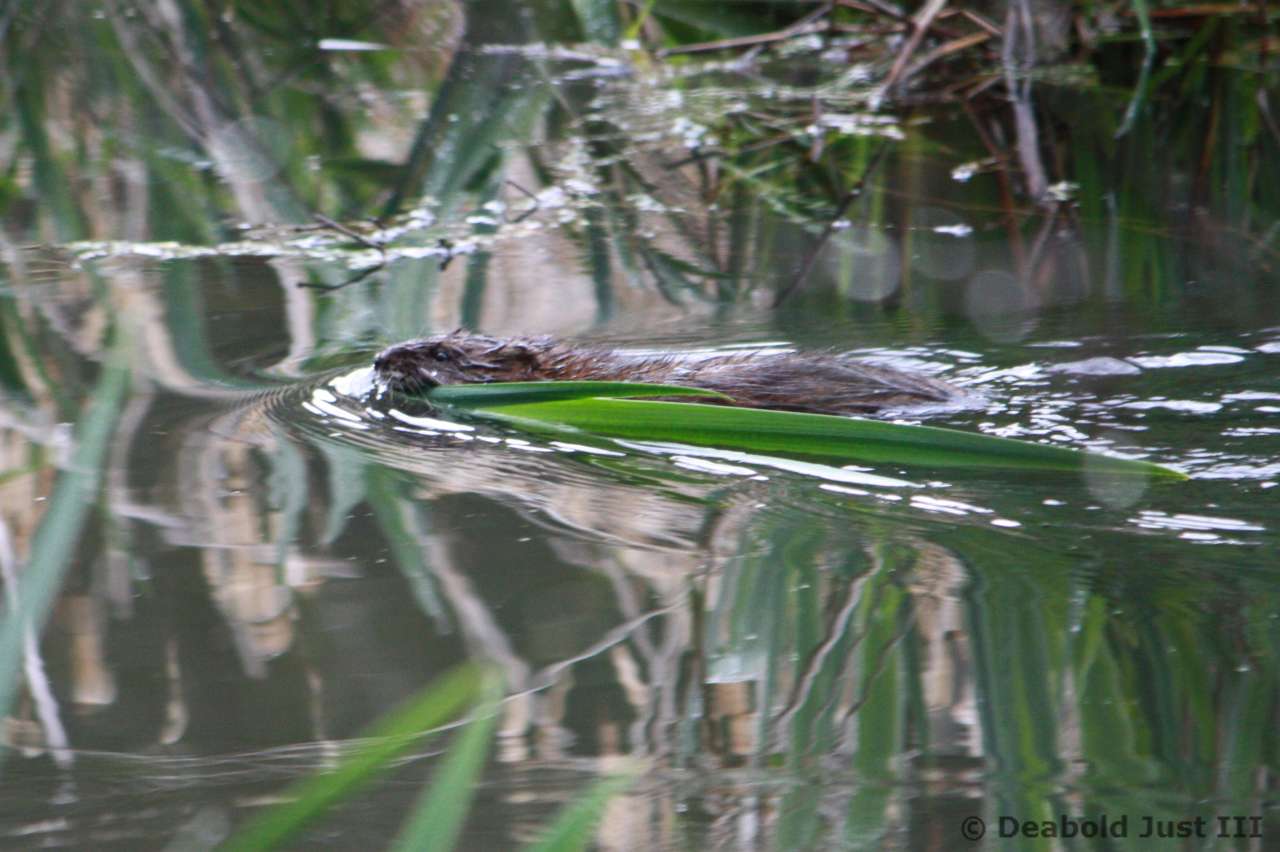
I went to recover the memory card from the remote wildlife camera I have monitoring the Wood Duck nest box at the Beaver pond after the winds died down. The drake was still guarding the pond waters beneath the nest box. While I was taking pictures of him swimming toward me the beaver approached from behind me and I did not see it until it swam into frame.


The beaver went about harvesting cattail shoots for breakfast.


I was well camouflaged and motionless as he approached. In my personal wildlife encounters having a wild wood duck and and a wild beaver swim with in twenty feet of my as I was taking pictures  was moving.


The fade away quartering shot.


To my surprise another hen Wood Duck had successfully hatched and escorted three young to the main pond near the man made dam. There is no way of knowing how many started the journey.


Some of the other creek residents opt for a less risky breeding plan. My new friend here has his territory all staked out and is busy chasing other males away. While watching carefully for intruding males he allowed a number of presumably females to tour the patch of cattails and shrubs he was lording over. He has a plan.

 The weather turned around today and was on of those spectacular days I had dreamed of. Winds died down to a breeze and temperatures went up twenty degrees. Giant fluffy Homer Simpson's clouds filled the sky. 

The tomatoes were covered and look great.

Sunday, April 25, 2010

Bandits at six o'clock!!!!


During the recent salmon release over a dozen visiting Bald Eagles were tolerated by the resident nesting pair. Some of the visitors were the offspring of this pair and some were just those that have figured out the timing of the feast laid out before them.

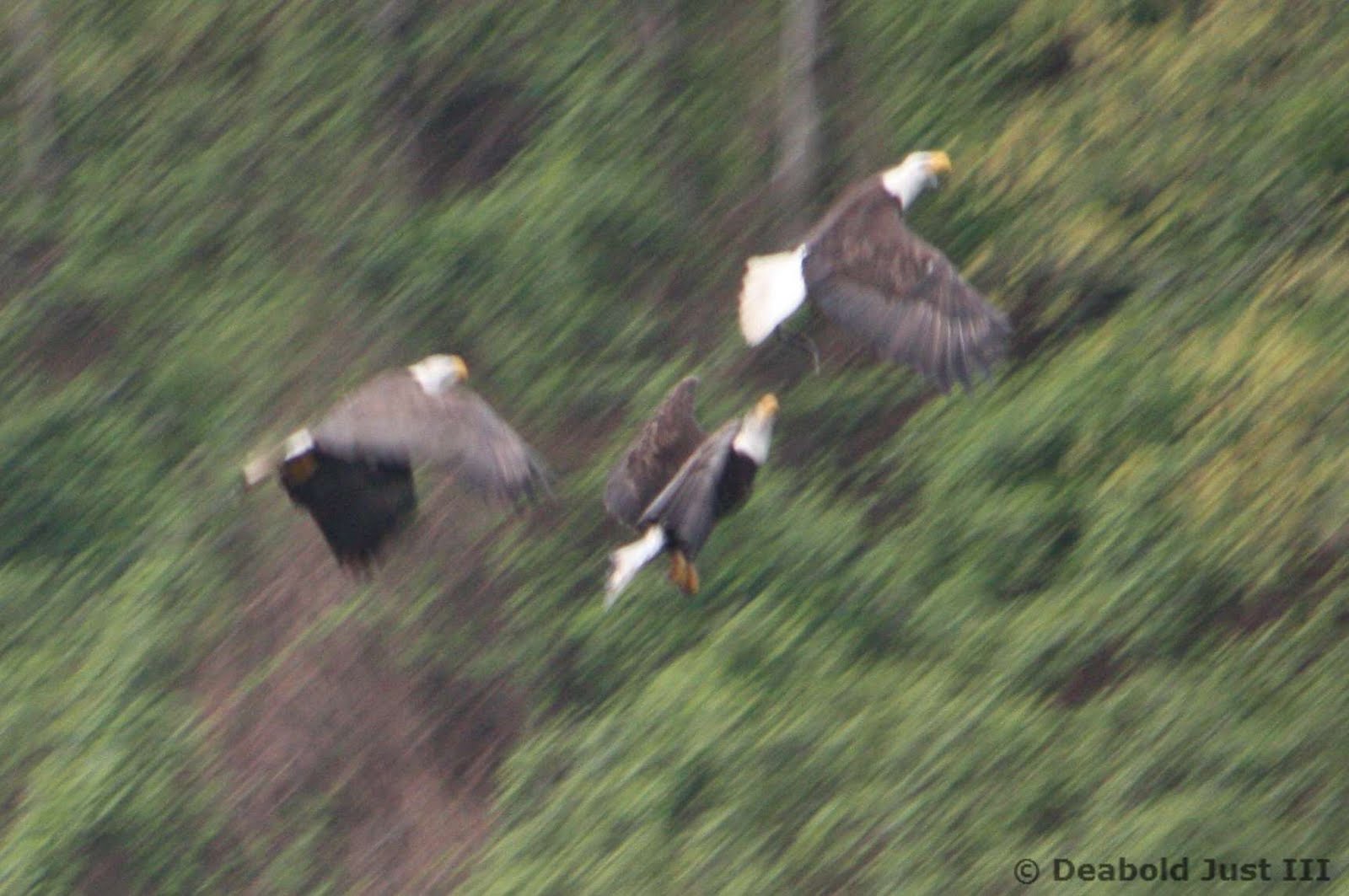
Even with enough fish for every eagle to catch and eat their fill they seem to relish the sport of stealing them from each other.  In some respects stealing fish from one another is actually a display their physical fitness and establishes a hierarchy for future mating opportunities.  Here is just one exchange that lasted only a few seconds but beautifully illustrates their grace and strength.


This series of photos started with a small flock of Common Mergansers herding a school of young salmon in to shallow water just ahead of the incoming tide. A "flock" of Bald Eagles lifted up off of the surrounding trees. I do not know how many Eagles make a flock but in one snap shot of time I could count thirteen eagles wheeling around over the fish in the shallows.


I believe the eagle bottom center is the resident male from the pair nesting in tree line behind these photographs. He swooped down through he firestorm of circling talons and neatly picked up a juicy young salmon. Instantly he was in a "dog fight" for his prize.  Seven of the eagles focused their attention on him and the chase was on. After one tight orbit four of the pursuers lost airspeed and dropped out of the race. About then I remembered that if I did not take any pictures I would not have any pictures. Duh. I missed about two seconds of the chase gawking.


The top eagle tried to cut the corner and close the distance between it's self and the leader but loses airspeed and falls behind.


Young eagles appear larger then adult eagles due to their feathers being slightly larger. Think of them as training feathers. There are advantages to this, more surface area equals more speed. The bottom eagle has been moving downward while closing the space between it's self and the prize.  Not having a fish to slow it down allows it just enough of an edge to close the gap.


The leader knows he is running out of time and space. The bottom eagle is now in a position to take the fish if the leader does not have the speed to pull away. The number three eagle knows the leader can not go lower so up is the only answer and starts to close that gap.


As the leader pulls up he looses airspeed and the trailing bandits know that one of them has a chance if they keep pushing.


The number two eagle is just inches away from reaching out and taking the fish with it's mouth while the number three is ready to pick it off in the air if number two misses.
A truly amazing feat of aerial skills!


Knowing when to cut your loss is critical. 
The leader's choices are limited. He had lost too much airspeed and cannot really afford an injury if the pursuing eagles overshoot the fish and the fish may not really be worth all of this effort to begin with. By dropping the fish suddenly he is of no interest. The number two bird applied the air brake too late to recover the falling fish before it hit the water below.


If you can not fly with the big birds, don't leave the perch!
  Our leader turns and takes out his frustration on an eagle that was not even in the chase! The number two bird dropped like a rock but could not keep up with the fish. 

None of these birds got the fish in the end, it fell back in to the shallows filled with Common Merganser bills that eagerly snapped it up.
This was just one of scores of aerial combat encounters. Some were winners and some were losers. Of course the salmon lost in almost ever case.

Friday, April 9, 2010

Dam it damn it...part three

If you have not read the other two parts of this blog please take the time and do it. Scroll down and you will find part two before you find part one.

http://birdmandea.blogspot.com/2010/02/dam-it-damn-it.html

http://birdmandea.blogspot.com/2010/02/dam-it-damn-itpart-two.html

Why? I do not want this blog entry to spoil anything for you. If you have been following the blog, I thank you and hope that after this one I will not have to apologize for it and you will continue to follow my blog.


Spring is here and it is a bitch. The temperatures for the first eleven days have been below normal with one storm after another.
The Canada Geese, Mallards, Wood Ducks and Crows have all paired off. Ravens are building nests and the Bald Eagles are sitting on their eggs.
Between the miserable bouts of weather I have been visiting the beaver’s pond hoping to catch a glimpse of the beavers. The winds have made trips into the woods to risky. After the last bout of wind storms heavy branches were littered everywhere and several were stuck in the ground like javelins. My remote camera has not been triggering on anything for the past three weeks.

On the days that I have ventured into the woods they have been spectacular. 


I went to the beaver pond to change the batteries in the remote camera. Before getting to the camera the large beaver swam out of the lodge and down stream the entire length of the pond. It was followed by a smaller beaver that could not hold it's breath as long. The little guy stopped, pulled out of the water and began to harvest a cattail for breakfast. I was able to photograph it as it returned to the lodge.


This male American Robin escorted me through his selected territory as I approached the beaver pond and he was there to escort me back through his territory as I left. He was very careful to ensure I did not spend anytime with out supervision, very careful.

 
The Bushtits are building their nests this month. They make a very unusual sock shaped nest decorated with bits of moss and lichen. If I had not heard the Bushtits arguing about where to put the next twig I would have never seen the nest at all. Here the Male is head first in the nest while the Female keeps a sharp eye on the front yard.


The Black Tailed Deer are shedding their winter coats leaving them looking scruffy and ragged.


A rare treat. A pair of Ravens are building a nest near the beaver pond. For the most part Ravens do not like to be near humans. The size of the creek drainage provides enough cover and privacy for them to feel comfortable enough to nest.


 While sitting over the beaver pond letting the sounds of the forest settle around me, I noticed an animal swimming through the flat waters. I thought it was the young beaver pictured above until it closed in on my concealed position. A wild Mink was patrolling it's territory. I was motionless and the sounds of the camera did not seem to effect the Mink's drive to get to where it was headed.


In the past I have seen one living Mink near the dam and one dead Mink on the bridge. Being able to capture a wild Mink with my camera is one of my proudest achievements.
(Obviously I am very easy to please.)


The Male Song Sparrows have also defined their territories. They will sing loudly to proclaim what is theirs but do not provide the escorts like the Robins do.


Wherever the ground is soaking wet Skunk Cabbage finds what it needs to thrive. This plant is a member of the Lilly family and is able to produce it's own heat to give it a jump on growing earlier in the season when the weather may turn too cool for other plants to grow. The flower is large and impressive. The fragrance is reminiscent of it's namesake. If there ever was proof that mother nature had a sense of humor here it is, a pretty flower that smells like a skunk.


The first rays of sun that reach through the thick canopy of our temperate rain forests fall on the Trilliums.  The flowers start out white and slowly become purple as the age.


Where the creek spills out of the canyon into the basin above the dam it has formed a broad sand bar. The local kids use the flat sands and shallow water to practice their skim boarding skills. As the weather warms scores of young people use the area to party. The local wildlife has to adapt to the "intrusion". The kids just want to have fun on the water and in the sun.


The unseen costs to the local wildlife become evident as the weather warms and the Canada Geese that  have selected the same sandbar to nest on are displaced by the kids. The effort to relocate the nest may be in vain. When they are displaced they may have difficulty in finding a suitable site that is not already taken by another pair. Canada Geese are not tolerant of over crowding during nesting season.


The Wood Ducks have paired off and are becoming secretive. Soon the Females will disappear to lay and incubate their eggs either in the few man made nest boxes placed in the woods or in natural cavities they find on their own deep in the woods. This Female Wood Duck is easy to track, she has a color abnormality around her eyes making her stand out from her sisters on the drainage.

The cost of emotional investment

This is a personal note, for me, one of the hardest things about watching a group of animals closely is that you begin to relate to them. You think you know them then and by doing so you tend to extend a level of emotion and empathy to their hardships.  I know at night when the winds hit sixty five miles per hour with the temperatures dipping to the high thirties and the rain starts, there is an eagle sitting on eggs in the top of a wildly swaying tree on the ridge line over the creek. In the morning I drive down there in my heated car with a cup of hot coffee after eating a hot breakfast to see if the tree is still there. So far it has survived. But I know the day may come. 


Remember this Beaver? S/he was the catalyst of this whole "Dam it Damn it" blog.

Yesterday the inevitable came to pass. In one of those twists of fate I was in the right place at the wrong time. The beaver I had found and photographed in the first blog entry “Dam it damn it” was dead on the side of the road.
Hit by a vehicle in the dark about six hundred yards for the safety of the pond. Six hundred yards from the smaller beaver I just showed you. Just one hundred feet from the safety of the creek. Why was it up on the hardtop? Who knows, who know what a beaver thinks. For my emotional investment, I am just left with a hole. I am torn, I want to go pull the remote camera and never go back while I want to watch and see if the beaver family survives. Beavers as a whole will but what about this family unit.

I went back down that road three hours after I found the cold body, it was gone. Who had taken it I do not know but if I had not seen it I would have never known and kept looking endlessly for it to surface in the pond.
Now I know I will not see it and that makes the thought of trekking in the forest just a little less appealing.

Life goes on. There are other adventures waiting to be lived and new chapters can not begin until old ones end.