Unconditional love or parasitism, you decide.
http://en.wikipedia.org/wiki/Parasitism
As a kid my father and I watched every nature show that was on TV. My father thought Marlin Perkins was a god. He did not think that Marlin's sidekick Jim was very bright. Jim had a tendency to jump on and wrestling every animal he came cross. Anyway, one of the animal shows that captured my imagination as a kid was one that showed the European Cuckoo and how it laid it's eggs in the nests of other birds and never participated in the rearing of their own young. It seemed so exotic, bizarre and far away.
As my experiences with birding expanded over the years I learned of the Brown Headed Cowbird found in the western states of the U.S.A. It has a similar method of leaving it's eggs in the nests of birds of other species to have them raise their offspring. When I moved to Western Washington I found Brown Headed Cowbirds lived here. So began my quest to get a picture of a Brown Headed Cowbird being fed by a host parent.
That was in 1976. Since then I have seen this young Cowbirds being fed by host birds twice but could not get any pictures of it. There is a very short period of time in each birds life where it follows it's parents around begging for food.
Let's shift back in time a couple months from today, a small nondescript Female Common Yellow Throat search the thick cattails of a backwater pond for a perfect nest location. She began to built her beautifully woven nest among the cattails keeping it high enough above the water line to prevent flooding if it rained and low enough to evade prying eyes.
Little did she know she failed. High above a dull colored silent female Brown headed Cowbird watched with infinite patience. She watched every move of the Yellow Throat to and from the nest location and even knew when the Yellow Throat had started laying her eggs. The Cowbird's timing was perfect, she had a narrow time frame between the start of the Yellow Throat's egg laying and the beginning of her incubation period after which there would be no chance to approach the nest undetected.
Evolution had given her an edge, her eggs are generic enough in color and size compared to a variety of possible host birds eggs so her opportunities to find a suitable nest to violate were greatly enhanced. Birds species that fall into the Cowbirds possible "victim" criteria are not always fooled by this slightly larger and slightly differently colored egg. Suspicious or older birds that had experienced this event prior would abandon the nest or build a new one on top of the intrusive egg as well as their own eggs in the nest. By doing this the hosts clutch of eggs are sacrificed.
Given that a Female Brown headed Cowbird will watch several to dozens of nests each breeding season, she and each of her equals find enough opportunities to keep their kinds numbers strong. The tragic down side of this form of parasitic nesting is that for each juvenile Cowbird egg that is discovered or hatches, two to six baby birds of the host are lost.
Yesterday my luck changed. I went of a short walk in the Nisqually Wildlife Refuge. It was overcast and muggy. As I was heading out I heard the begging cries of a young bird in a dense patch of cattails. I waited a few minutes hoping that it would eventually move into the open. Finally when it did expose it's self I thought it was a young Red Winged Blackbird by shape and color but that quickly changed when a few seconds later a Male Common Yellow Throat flew out of the cattails with a bug and taunted the young begging bird. I knew instantly I had found what I had been looking for all these years. I took a series of forty to fifty pictures. Low light and distance prevented the quality I had hoped for but that is how it goes.

Here a male Common Yellow Throat flies out of the thick cattails calling to the young Brown Headed Cowbird.

Out comes the Cowbird fledgling.

The Male Common Yellow Throat would catch insects and then lead the young Cowbird around in circles making it take to wing in an effort to be fed.
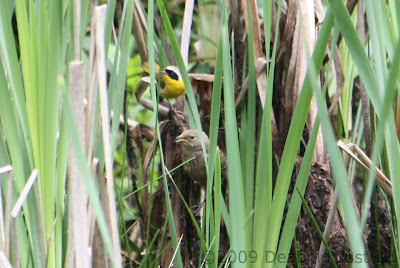
The young Cowbird's size is an indicator of how daunting the task of feeding it is.

First up high then down low to the Duckweed covered surface of the pond.

The needs of the one young Cowbird must equal or exceed the needs of the Yellow Throat's own young if they had survived to this point. The Cowbird is relentless in it's need for food.
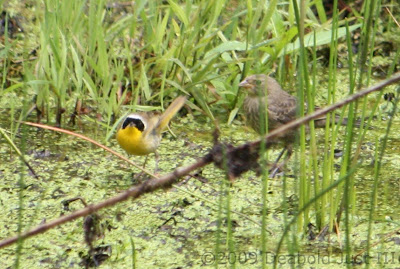
So is the Cowbird a parasite or just smarter then the rest of the birds in it's ecosystem? Does the Common Yellow Throat know it is being used and willingly going along with it?

Is the urge to feed a young bird so strong that the Yellow Throat is blind to what is going on?

In a few weeks the young Cowbird will fly off and find a flock of others of it's own kind. Some will have been raised by Common Yellow Throats and many others will have been raised by a variety of other bird species. How do all of the young Cowbirds figure out that the are Cowbirds and not what their host parents were? How can they recognize their own kind without ever seeing them? How do they learn their songs to attract a mate to continue this cycle. There are a number of theories as there always are when the answer is as elusive as this.
Human observers tend to see the Cowbirds as a scourge of the bird community that causes the deaths of thousands of young song birds across the cowbirds range each breeding season.
You will have to decide for yourself. The system has worked like this for thousands of years and should continue for thousands of years after we are gone.
It is only when we and our ways tip the balance through the things we do that the Cowbirds actions make a greater difference.


 Female
 Male
Male The Females belly
 Female
 Here the Female is on the left and the Male to the right.
 The Male slowly and gently approached the Female cautiously extending his front legs as if trying to reach over the Female. He is gently tapping the web in front of him.
 Several slow tapping approaches seemed to sooth the Female and with each gentle tap she retracted her defensive posture and drew her front legs back to toward her body.
 This is his first actual contact.
 She pulled back quickly and seemed to relax.
 Here you can see how precariously her hangs by the tiny hooks on her feet.
 A couple more taps and she exposes her belly.
 My Camera can take three pictures per second so here you see the whole act of copulation in less then one second.
 In an instant the Male was gone. I thought he had fallen from the web. I lowered the camera and saw him two feet away running for his life! The Female was moving very slowly toward him.
 The Male is in the upper right and Female lower left. She seemed to be disorientated or dazed as he took up a distant position to look back and see if it was clear to move on to the next Females web. He has a lot to choose from this year.
 Spiders are a great indicator of the environmental health of a given area. They provide high protein snacks for the birds migrating south as well as those who will be spending the Winter months here. The Bewick's Wrens are sulking through out the Black Berry bushes filling up on them.
 Here a male Common Yellow Throat flies out of the thick cattails calling to the young Brown Headed Cowbird.
 Out comes the Cowbird fledgling.
 The Male Common Yellow Throat would catch insects and then lead the young Cowbird around in circles making it take to wing in an effort to be fed.
 The young Cowbird's size is an indicator of how daunting the task of feeding it is.
 The needs of the one young Cowbird must equal or exceed the needs of the Yellow Throat's own young if they had survived to this point. The Cowbird is relentless in it's need for food.
 So is the Cowbird a parasite or just smarter then the rest of the birds in it's ecosystem? Does the Common Yellow Throat know it is being used and willingly going along with it?
 Is the urge to feed a young bird so strong that the Yellow Throat is blind to what is going on?
 A young Waxwing refuses to take to wing and follow it's parent. After dozens of attempts to get the young bird to fly a passing Crow spooked the the youngster and it dropped straight down out of sight.
 On the other side of the yard this Robin was trying to coax it's young out of the nest with a big mouthful of juicy worms.
 Here the local Male Anna's hummingbird lords over his domain.
 Here is one of his offspring that recently fledged.
 No holding back.
 The area is a complex mix of rocky, muddy and sandy beach so there is something for everyone who lives here. A number of crab species are found here.
 Sand dollars breed here.
 This is a Harbor Seal, the dogs splashing in the water drew it in fairly close to see what was going on. Typically when you see a seal there are more around. They are shy and sneaky, but will sometimes come surprisingly close. They are usually around long before you notice them. When Sea Lions show up the Harbor Seals disappear.


 I could not tell what kind of fish it was but then again I am not going to eat it.
 Everyone wants a free lunch! This Crow was in hot pursuit but never had a chance to catch up.


