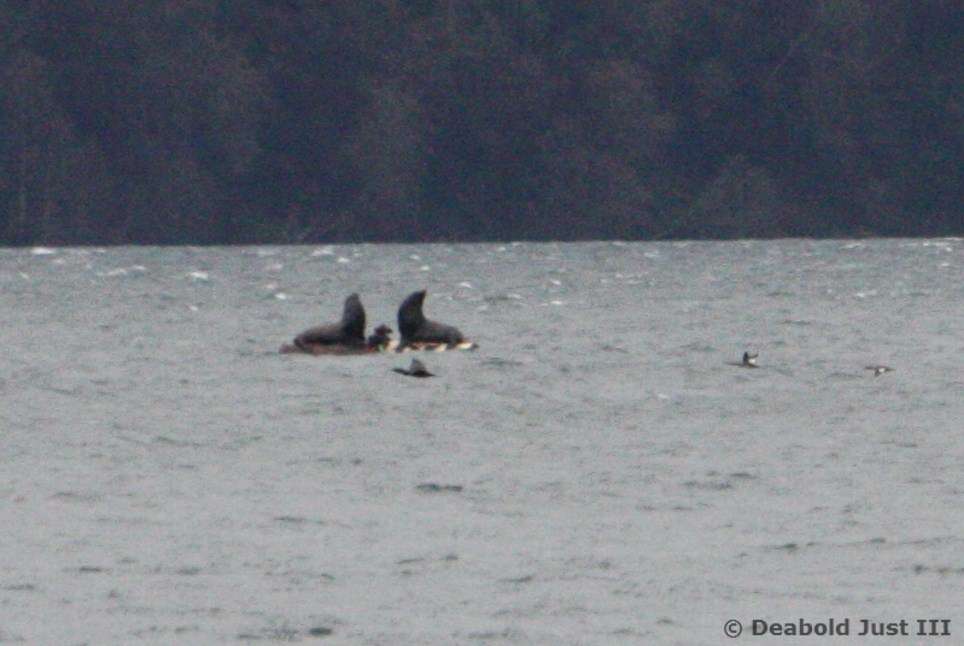
A little over a year ago I wrote the Blog “Where the Lions Roam”. It was about a Sea lion feeding on a Salmon in open water.
http://birdmandea.blogspot.com/2009/11/sea.html
I was unaware at the time that it was the start of the 2009 Chum Salmon run. I later learned that the run was very disappointing compared to previous years. Countless animals that depend on the high energy food during the dead of winter went without.
Chum Salmon. A name can say a lot. It is also know as “Dog salmon”.
Compared to other salmon species on the Eastern rim of the Pacific Ocean the Chum has been not the most preferred by humans.With the pressures of overfishing and environmental change many of the more desirable species have declined to a point where the Chum is now being viewed as a more important part of the economic biomass as a sport and commercial asset to be utilized to its fullest. As if it wasn't already hard enough on the wildlife that depends on this annual and fickle bonanza, man's role again just increases the pressure.

December, 2010 at the foot of the dam I saw this big boy cruising slowly head on toward the dam then diving under and floating away from the dam submerged. While he was underwater I could move closer and find a little cover.
I was unaware at the time that it was the start of the 2009 Chum Salmon run. I later learned that the run was very disappointing compared to previous years. Countless animals that depend on the high energy food during the dead of winter went without.
Chum Salmon. A name can say a lot. It is also know as “Dog salmon”.
Compared to other salmon species on the Eastern rim of the Pacific Ocean the Chum has been not the most preferred by humans.With the pressures of overfishing and environmental change many of the more desirable species have declined to a point where the Chum is now being viewed as a more important part of the economic biomass as a sport and commercial asset to be utilized to its fullest. As if it wasn't already hard enough on the wildlife that depends on this annual and fickle bonanza, man's role again just increases the pressure.

December, 2010 at the foot of the dam I saw this big boy cruising slowly head on toward the dam then diving under and floating away from the dam submerged. While he was underwater I could move closer and find a little cover.

As I was waiting for the sea lion to surface I side stepped closer to the edge of the water when a salmon splashed as it took off for deep water. I will admit it, it startled my and I compromised my hiding spot.

A moment later either it or another was right back in the same spot. These salmon are done, few will ever make it over the dam, for the few that do there is no where to spawn and their lives end in the shallows of the creek. Now I had a salmon two feet away while a sea lion patrolled less then twenty-five feet away. I had been crouching up to this point, I stood up, the salmon took off and the sea lion noted my presences and slowly moved off to deeper water.

*****************************************
On my way home I looked out to the water as I passed our local beach. I could see a large swirl on the water’s surface a few yards out from the Volleyball sand pit. I pulled into the parking lot and headed for the beach on foot. The tide was still high so there wasn’t much of a beach. I used the trees at the high water line to cover my approach. The sea lion had been slowly moving Westerly from where I had originally spotted it and now I was to the East of it.

The seal lion was holding this salmon by the gills. It appeared to be dead and the sea lion was slowly swimming with no real intention of going any where or of letting the salmon go.

This by it's self seemed odd but I tought it was an isolated incident and made a folder and moved on to other things. Although birds tend to be my primary interest all animals I encounter get a folder. I have a lot of folders.
A couple days later I drove to the dam during a late morning downpour. The icy rain was being whipped around by gusty unpredictable winds. The sky was black and a monotone gray was the only color one could see.

When I got to the dam this Harbor Seal surfaced with a salmon in it’s mouth. I shot a quick series of pictures as the seal looked at me turned and took off. I strung them together into a short movie that I posted on my Flickr page.

Even through the view finder of the camera I could see this seal's eye turn a catch me looking at it.

Now s/he is showing me what a big fish s/he has

I do not know how to put a movie into this blog or if it can be done.
Here is the link if you would like to take quick look.
http://www.flickr.com/photos/25348030@N07/5255120035/
I was about to hit the "publish post" button and send this blog post on it's way to you but I though one more trip to the dam might be worth it and after all there is no dead line or anything like that going on here. There was always the hope that I might get better light. Two days later I took the following collection series of pictures. Honestly. I took close to a 400, gotta love those digital cameras. And I did not even have to change the battery!
I timed my visit to coincide with the high tide. This put about fourteen feet of water at the foot of the dam and made hunting easy for the seals. I waited until the two patrolling seals dove under and I jumped out of the car and got in to my hiding spot I had chosen on my previous visits.

They surfaced and saw a car pulling up behind mine. The car stopped for a moment the backed out and drove off, during the distraction the seals overlooked me as I hunkered down and set the camera up to match the lighting conditions them the best I could. I took all of these pictures through a chain link fence. Careful attention to lens position and angle helped to keep the pictures clear and usable.

An instant later the larger of the pair turned and pounced on a salmon. The larger seal is fairly agressive toward the others in the area and I am assuming that it may be a male. I could be wrong but I am pretty sure like most other predatory animals that is how it works.


He is not acting as if he wants to share. I have never seen much in the way of facial expression in the seals but their eyes seem to be rather telling. You can just make out the outline of the fish to the left of his mouth.

I am going to take a quick time out here and ask a few questions.
Is that the most amazing natural camouflage pattern or what? Sure a Tiger is awe inspiring but this color and pattern combination is simply amazing. How did they do that?

The seals appear to hold the fish by the head preventing water from reaching the gills killing the fish.

Holding the salmon with his flippers, he opens the fish open as if it had a zipper.

Salmon eggs spill out in to the water.


The salmon is reduced to several large jagged chunks that are bolted down in seconds. Then all is quiet.
*********************

Less then eight minutes later He has another big "hen" in his jaws.

After swimming a few slow circles with the fishes head out of the water there is no more fight.

Then he holds the fish by the gills. From this angle you can see the belly of the salmon swollen with eggs.

This time the Common Mergansers, Barrow's Golden Eyes and Gulls in the area moved in to grab what the could. This lucky Male Merganser came up with a mass of eggs.

The more the seal ate the bolder the Mergansers became moving in closer and closer to recover the scraps.


Well there goes my cover.

See you next year.
A very good run indeed.